

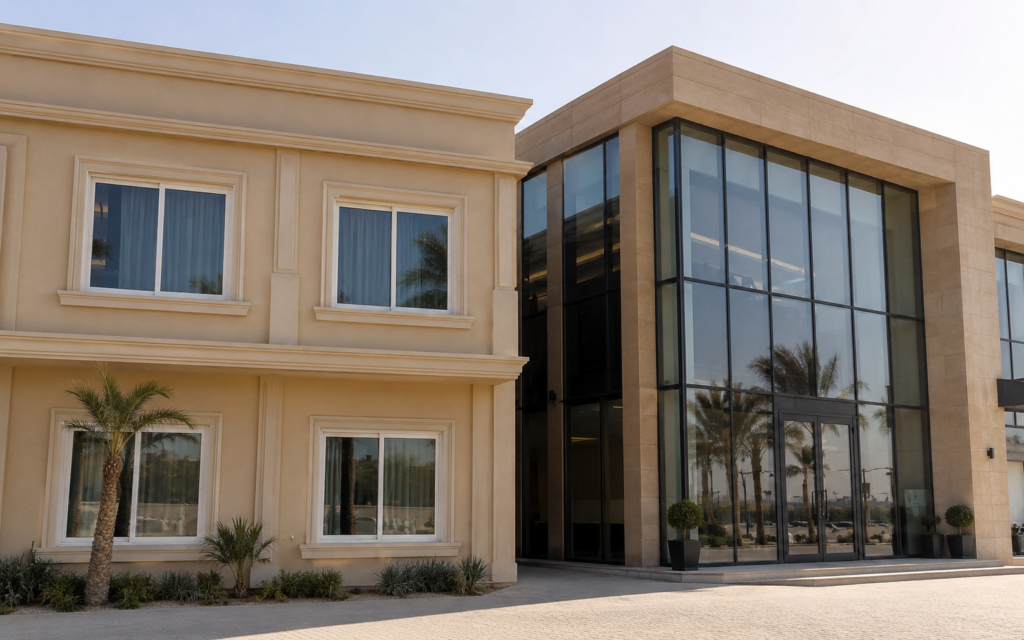
The right window material depends on more than appearance. In Saudi Arabia, factors such as heat, sunlight, maintenance, insulation, opening size, durability, and architectural style all influence which system is more suitable for a project.
Both UPVC and aluminum windows can perform well when correctly specified and installed, but they offer different strengths. The better choice depends on the type of building, the performance required, and the design priorities of the project.
Understanding the Difference
UPVC and aluminum are both widely used for modern window systems, but they behave differently as framing materials.
UPVC is commonly selected for its insulation properties, low maintenance, and practical performance in residential and commercial applications.
Aluminum is often preferred where slim profiles, larger openings, structural strength, and a more architectural appearance are important.
Neither material is automatically better for every project.
1. Thermal Performance
Thermal performance is especially important in Saudi Arabia because buildings are exposed to high outdoor temperatures for much of the year.
UPVC naturally offers good resistance to heat transfer through the frame, making it a strong option for projects focused on indoor comfort and insulation.
Aluminum is a highly conductive material, but modern aluminum systems can use thermal-break technology to improve insulation performance.
For projects where thermal efficiency is the main priority, UPVC can offer a practical advantage. For aluminum systems, the profile design and thermal-break specification become especially important.
2. Strength and Large Openings
Aluminum offers excellent structural strength relative to its profile size.
This allows it to support larger window and door openings while maintaining slimmer visible frames.
It can be especially suitable for:
- Large glazed openings
- Contemporary villas
- Commercial buildings
- Offices
- Architectural façades
- Wide sliding systems
UPVC can also be used across many residential and commercial openings, but system selection should consider the dimensions, reinforcement, glazing weight, and opening configuration.
3. Architectural Appearance
The visual character of the building can strongly influence the choice between the two systems.
Aluminum is often associated with slim profiles, clean lines, and contemporary architectural detailing.
UPVC generally has a slightly different profile appearance but can still provide a clean and modern finish, particularly for residential buildings where thermal comfort and practicality are priorities.
The best choice should complement the building rather than being selected independently from the architecture.
4. Maintenance Requirements
Both systems can offer relatively low-maintenance performance when good-quality materials and hardware are used.
UPVC does not require regular painting and has good resistance to moisture and corrosion.
Aluminum also offers excellent durability and corrosion resistance when appropriate finishes and coatings are specified.
Routine maintenance for either system should include cleaning, checking seals, and ensuring that hardware continues to operate correctly.
5. Weather Resistance
Saudi projects must deal with strong sunlight, heat, dust, and changing environmental conditions.
Good weather resistance depends on more than the frame material.
Important factors include:
- Profile quality
- Sealing system
- Gasket condition
- Drainage design
- Glass specification
- Hardware
- Fabrication accuracy
- Installation quality
A poorly installed premium system can perform worse than a correctly installed standard system.
6. Glazing Options
Both UPVC and aluminum window systems can be combined with different glass specifications.
Depending on project requirements, glazing can be selected to support:
- Thermal insulation
- Solar heat reduction
- Acoustic performance
- Safety
- Privacy
- Architectural appearance
The glass should be selected together with the frame system to create a complete performance solution.
7. Sound Insulation
Acoustic performance depends heavily on glazing, sealing, profile design, and installation quality.
UPVC systems can perform well in projects where reducing outside noise is important, particularly when combined with suitable acoustic glazing and effective sealing.
Aluminum systems can also provide strong acoustic performance when the correct profiles, glass, and sealing details are used.
For properties near major roads, commercial areas, airports, or other noisy environments, acoustic requirements should be discussed during system selection.
8. Opening Configurations
Both materials are available in different opening styles.
Common options may include:
- Sliding windows
- Hinged windows
- Inward-opening windows
- Outward-opening windows
- Fixed glazing
- Multi-panel configurations
The right opening style should be selected according to room layout, ventilation needs, available space, cleaning access, and architectural design.
9. UPVC May Be Better When…
UPVC can be a strong choice when the project prioritizes:
- Thermal insulation
- Indoor comfort
- Low maintenance
- Practical residential performance
- Reliable sealing
- Energy-conscious design
- Cost-effective window solutions
It is commonly suited to villas, apartments, residential developments, offices, and other climate-controlled spaces.
10. Aluminum May Be Better When…
Aluminum can be particularly suitable when the project requires:
- Slim architectural profiles
- Large openings
- Greater structural strength
- Contemporary design
- Wide sliding systems
- Commercial applications
- Architectural flexibility
It is often selected for premium villas, offices, commercial buildings, and projects with larger glazed openings.
Can UPVC and Aluminum Be Used in the Same Project?
Yes.
A project does not necessarily need to use only one window material throughout the entire building.
UPVC may be selected for areas where thermal comfort and insulation are priorities, while aluminum may be used for larger openings or locations where slimmer architectural profiles are preferred.
The final selection should be coordinated so that materials, finishes, glass, and visual detailing remain consistent across the building.
Which Is Better for Saudi Arabia?
There is no single answer for every project.
For many residential applications where insulation, sealing, and low maintenance are key priorities, UPVC can be an excellent solution.
For projects requiring larger openings, slimmer frames, structural strength, and highly contemporary detailing, aluminum may be the stronger choice.
The correct decision should be based on the complete project requirement rather than choosing one material simply because it is more popular.
What Should You Compare Before Choosing?
Before selecting UPVC or aluminum windows, compare:
- Opening dimensions
- Thermal requirements
- Glass specification
- Acoustic requirements
- Frame appearance
- Opening configuration
- Hardware requirements
- Weather exposure
- Maintenance expectations
- Architectural style
- Installation method
- Project budget
Considering these factors together makes it easier to choose a system that performs well and fits the architecture.
Final Thoughts
UPVC and aluminum windows both have valuable applications across Saudi residential and commercial projects.
UPVC offers strong insulation potential, practical performance, and low maintenance, while aluminum provides structural strength, slim profiles, and greater flexibility for large architectural openings.
Global Prestige provides both UPVC and aluminum door and window solutions, allowing the system to be selected according to the actual performance and architectural requirements of each project.