

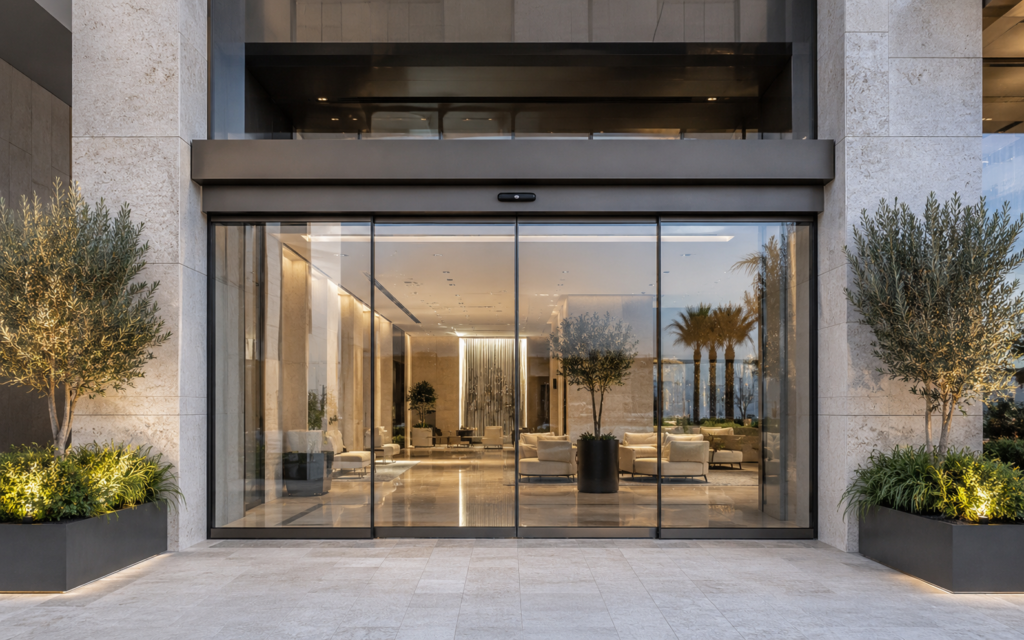
Automatic glass doors are widely used in modern commercial and public buildings because they combine convenient access with a clean, transparent architectural appearance.
They are especially useful in locations where people move in and out frequently, where accessibility is important, or where the entrance needs to feel open and professional without relying on a conventional manual door.
Why Automatic Glass Doors Are Popular
A well-designed automatic glass entrance can improve both the user experience and the visual quality of a building.
The system allows people to enter and exit smoothly while keeping the entrance clear, modern, and easy to use.
Automatic glass doors are commonly selected for spaces where convenience, traffic flow, appearance, and reliable operation are all important.
1. Ideal for High-Traffic Entrances
Automatic glass doors are particularly useful in places where doors are opened and closed repeatedly throughout the day.
This can include:
- Hotels
- Hospitals
- Shopping centres
- Offices
- Airports
- Retail stores
- Commercial buildings
- Public facilities
Automatic operation helps reduce congestion and allows people to move through the entrance more efficiently.
2. Better Accessibility
One of the main benefits of automatic doors is easier access.
Users do not need to manually pull or push the door, which can make entrances more convenient for:
- Elderly visitors
- People carrying bags
- Wheelchair users
- Families with children
- Staff moving equipment
- Visitors with limited mobility
For public and commercial environments, this can significantly improve the overall entrance experience.
3. Clean and Modern Appearance
Glass entrances help maintain visual openness while allowing natural light into the building.
Automatic systems can create a refined entrance without adding visually heavy door elements.
They work particularly well with modern architectural materials such as:
- Glass façades
- Aluminum framing
- Stainless steel
- Stone finishes
- Minimal interior design
The result is a more contemporary and professional appearance.
4. Suitable for Hotels and Hospitality Projects
Hotels require entrances that feel welcoming, easy to use, and visually refined.
Automatic glass doors can provide smooth guest access while helping the lobby remain open and visually connected to the exterior.
They are also practical for guests carrying luggage or moving through busy entrance areas.
5. Strong Choice for Offices and Commercial Buildings
Corporate offices and commercial buildings often require entrance systems that can handle regular daily traffic while maintaining a professional image.
Automatic glass doors can help create:
- Clear entry points
- Efficient movement
- Modern reception areas
- Better accessibility
- Clean architectural presentation
The system can be coordinated with surrounding glass partitions, façades, and aluminum systems to create a more consistent entrance design.
6. Useful in Retail Environments
Retail entrances benefit from being easy to approach and simple to use.
Automatic doors can help make the entrance feel open and welcoming while allowing customers to enter without interrupting their movement.
They are especially useful in busy stores, supermarkets, malls, and other spaces where customers frequently enter and exit.
7. Appropriate for Airports and Public Facilities
Airports and public facilities often deal with continuous pedestrian movement.
Automatic glass doors can support smoother circulation while reducing the need for manual operation.
In these environments, the system should be selected carefully around:
- Traffic volume
- Opening width
- Sensor requirements
- Safety features
- Glass specification
- Operator performance
- Maintenance access
Reliable operation becomes especially important in locations that remain active for long periods.
8. Sensors and Safety Features Matter
Automatic doors depend on sensors and control systems to operate correctly.
Suitable sensors can detect approaching users and trigger the opening mechanism while helping maintain safe movement through the entrance.
Depending on the system and project requirements, automatic glass doors may include:
- Motion sensors
- Presence sensors
- Safety detection
- Adjustable opening speeds
- Controlled closing
- Emergency operation features
The selected system should be appropriate for the expected traffic and building use.
9. Glass Specification Should Match the Application
The glass itself should be selected according to the location and performance requirements.
Important factors can include:
- Safety
- Panel dimensions
- Frequency of use
- Visibility
- Architectural appearance
- Environmental exposure
- Door weight
Glass selection should be coordinated with the operator and hardware system rather than treated as a separate decision.
10. Correct Installation Is Essential
Automatic door performance depends heavily on installation quality.
Tracks, operators, sensors, glass panels, frames, and supporting components must be correctly positioned and aligned.
Professional installation should include:
- Accurate site measurement
- Correct operator positioning
- Precise track alignment
- Secure glass installation
- Sensor setup
- Hardware adjustment
- Operational testing
- Final finishing
Small alignment or setup issues can affect smooth operation and long-term reliability.
What to Consider Before Choosing an Automatic Glass Door
Before selecting a system, review:
- Entrance width
- Expected traffic volume
- Door configuration
- Glass specification
- Operator requirements
- Sensor type
- Safety requirements
- Available installation space
- Architectural finish
- Maintenance requirements
The best system is one that matches the actual use of the entrance.
Sliding Automatic Doors vs Other Configurations
Automatic sliding glass doors are among the most common options because they provide efficient access without requiring additional swing space.
They can be particularly suitable for:
- Narrow entrance zones
- Busy commercial areas
- Hotel lobbies
- Retail entrances
- Office buildings
- Public facilities
The final configuration should be selected according to the opening dimensions, traffic flow, and surrounding architecture.
Maintenance and Long-Term Performance
Automatic glass doors are mechanical systems and should be maintained regularly.
Routine checks can help identify issues with:
- Sensors
- Rollers
- Tracks
- Operators
- Door alignment
- Glass fittings
- Safety functions
Regular maintenance helps support smoother operation and reduces the risk of unexpected downtime.
Final Thoughts
Automatic glass doors work best in environments where accessibility, frequent movement, modern appearance, and smooth operation are important.
Hotels, offices, retail spaces, airports, healthcare facilities, and commercial buildings can all benefit from a properly selected and professionally installed system.
Global Prestige provides automatic glass door solutions with support for measurement, system planning, glass preparation, installation, sensor setup, alignment, and final operational checks.