
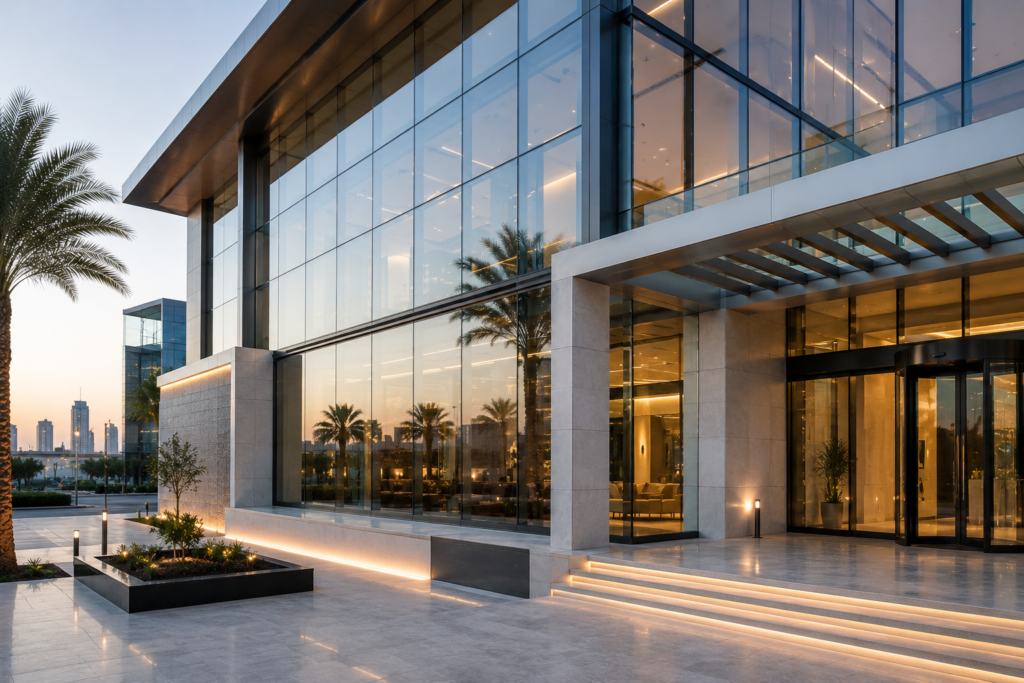
Modern buildings are increasingly defined by clean lines, transparency, durable finishes, and carefully coordinated materials. Glass and metal systems play a major role in creating that appearance while also supporting safety, access, separation, protection, and long-term building performance.
When these systems are properly selected and installed, they do more than improve appearance. They help create spaces that feel lighter, more open, more functional, and better suited to contemporary residential and commercial architecture.
Why Glass and Metal Work So Well Together
Glass and metal complement each other because they offer very different qualities.
Glass brings transparency, natural light, openness, and visual continuity.
Metal adds strength, structure, durability, precision, and definition.
Together, they can create architectural systems that feel refined without becoming visually heavy.
This combination is widely used in:
- Villas
- Commercial buildings
- Offices
- Hotels
- Retail spaces
- Airports
- Residential towers
- Public facilities
1. They Create a Cleaner Architectural Appearance
One of the main reasons glass and metal systems are used in modern buildings is their visual simplicity.
Minimal framing, clean joints, precise edges, and transparent surfaces can help create a more refined architectural language.
This is particularly effective in projects where the design focuses on:
- Straight lines
- Large openings
- Open interiors
- Minimal detailing
- Contemporary finishes
- Strong material contrast
2. Glass Helps Maintain Openness and Natural Light
Glass allows spaces to remain visually connected.
Instead of fully closing off areas with solid materials, glass can create separation while still allowing light and views to pass through.
This is useful in applications such as:
- Office partitions
- Stair railings
- Balcony railings
- Entrance systems
- Internal divisions
- Glass doors
The result is a building that feels brighter and more spacious.
3. Metal Provides Strength and Precision
Metal systems are often used where strength, support, durability, or accurate structural detailing is required.
Depending on the application, aluminum, stainless steel, or steel can be used for:
- Frames
- Railings
- Cladding
- Handrails
- Supports
- Profiles
- Fixing systems
- Architectural details
The correct material should be selected according to the technical and visual requirements of the project.
4. Glass Railings Improve Safety Without Blocking Views
Glass railings are a strong example of how architectural systems can combine function and appearance.
They provide edge protection around balconies, staircases, terraces, and elevated areas while maintaining visibility.
This helps preserve:
- Exterior views
- Natural light
- Interior openness
- Visual continuity
Frameless or minimal-profile systems can create an especially clean result when precise installation and suitable glass specifications are used.
5. Glass Partitions Improve Interior Planning
Glass partitions help organize offices and commercial interiors without creating visually heavy spaces.
They can define:
- Meeting rooms
- Executive offices
- Work areas
- Reception spaces
- Conference rooms
- Showrooms
Privacy can also be introduced through frosted glass, films, patterned finishes, or other suitable treatments.
This allows the interior to balance openness with practical separation.
6. Metal Cladding Can Strengthen the Building’s Visual Identity
Cladding is not only a protective surface.
It can also become an important architectural feature.
Aluminum or steel cladding can be used to create:
- Defined façade zones
- Feature surfaces
- Entrance details
- Architectural bands
- Exterior panels
- Interior feature areas
Panel size, joint spacing, finish, alignment, and edge detailing all affect the quality of the final appearance.
7. Automatic Glass Doors Improve Modern Entrances
Entrances are one of the most visible parts of a building.
Automatic glass doors can create a cleaner and more accessible entrance while supporting high pedestrian movement.
They are especially useful for:
- Hotels
- Offices
- Retail spaces
- Airports
- Hospitals
- Commercial buildings
Glass allows the entrance to remain visually open, while the automatic system improves convenience and movement.
8. Stainless Steel Adds a Refined Architectural Finish
Stainless steel is widely used in modern architecture because it combines durability with a clean visual finish.
It can be used for:
- Railings
- Handrails
- Architectural trims
- Fixings
- Decorative elements
- Protective details
- Custom fabrication
Different finishes can create different visual effects, from polished surfaces to brushed or satin appearances.
9. Material Coordination Is Important
A premium architectural result depends on how materials work together.
Glass, aluminum, stainless steel, steel, hardware, sealants, and surrounding finishes should be coordinated rather than treated as separate items.
Important considerations include:
- Finish consistency
- Joint alignment
- Profile dimensions
- Hardware selection
- Glass specifications
- Fixing details
- Edge conditions
- Color coordination
Small inconsistencies can become very visible in minimal architectural designs.
10. Installation Quality Defines the Final Result
Even high-quality materials can look poor if they are installed inaccurately.
Architectural glass and metal systems require careful measurement, fabrication, alignment, fixing, and finishing.
Professional execution should focus on:
- Accurate site measurements
- Correct material preparation
- Precise fixing positions
- Consistent panel alignment
- Clean joints
- Secure installation
- Hardware adjustment
- Final finishing
The more minimal the system looks, the more important installation precision becomes.
Where Architectural Glass and Metal Systems Add the Most Value
These systems can improve a wide range of building areas, including:
- Main entrances
- Balconies
- Staircases
- Office interiors
- Building façades
- Reception areas
- Terraces
- Commercial interiors
- Hotel spaces
- Public circulation areas
Each application should be designed around its own safety, durability, maintenance, and architectural requirements.
What to Consider Before Selecting a System
Before finalizing an architectural glass or metal system, review:
- Project type
- Interior or exterior use
- Required performance
- Glass specification
- Metal type
- Surface finish
- Fixing method
- Safety requirements
- Maintenance access
- Architectural appearance
- Installation conditions
A well-coordinated system should provide both technical performance and visual quality.
Final Thoughts
Architectural glass and metal systems can significantly improve modern buildings by combining openness, strength, durability, functionality, and refined detailing.
The strongest results come when the materials, hardware, fixing systems, finishes, and installation are planned as one complete architectural solution.
Global Prestige provides glass, aluminum, stainless steel, steel, railing, partition, cladding, and entrance solutions for residential and commercial projects, with attention to precise execution and clean architectural finishing.